
Nitrogen is one of the most important inputs in crop production and one of the most difficult to manage well.
At Stenon, as experts in nitrogen management, we work with a simple principle: better nitrogen decisions start with better information. Knowing how much plant-available nitrogen is actually present in the soil is an essential part of that information. But the number alone is not enough. To make a good agronomic decision, we also need to understand how the crop uses nitrogen, when it needs it, and what happens when supply and crop demand are out of sync.
This article opens a new Stenon series dedicated to the science behind nitrogen management. Each month, we will explore an agronomic aspect of nitrogen: from plant demand and soil nitrogen dynamics to mineralization, losses, nitrogen-use efficiency and the practical decisions farmers face in the field.
We begin with the plant itself.
Why nitrogen is different
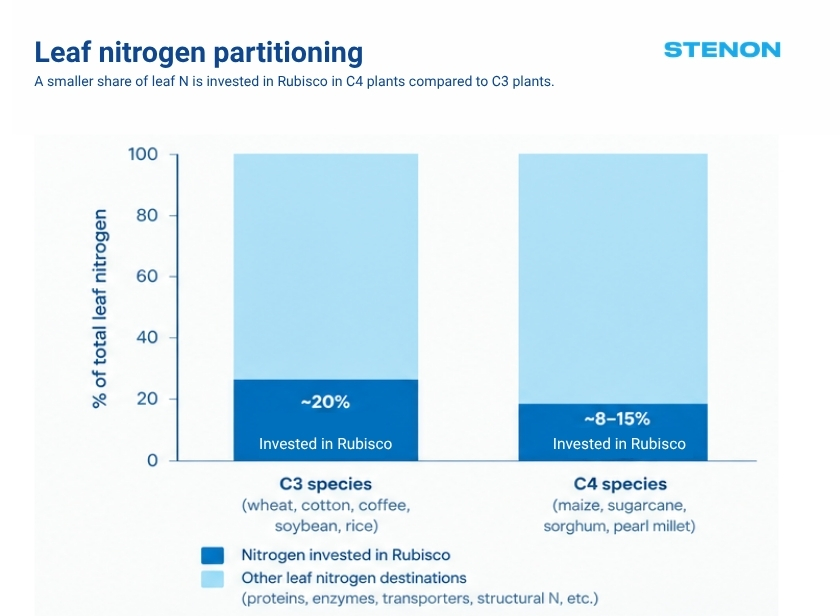
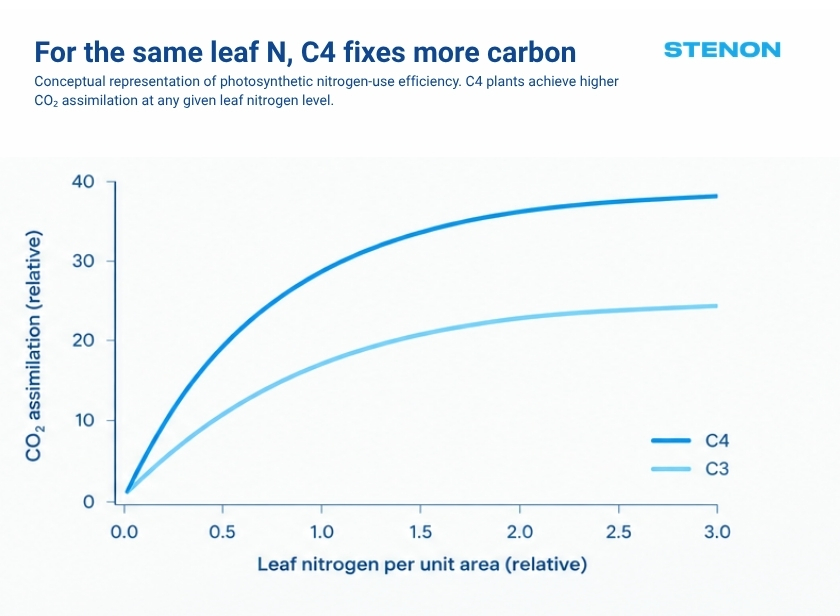
Nitrogen does not have one isolated function inside a plant. It is part of much of the machinery that keeps the plant growing: proteins and enzymes, chlorophyll, nucleic acids and other essential compounds.
This explains why nitrogen deficiency can have such a broad impact. When N becomes limiting, the effect is not restricted to a single process. Leaf development, photosynthetic capacity and the plant’s ability to build and ultimately fill the harvested product can all be affected. Because nitrogen is mobile within the plant, older leaves can also become a source of N for younger tissue when supply is insufficient.
Sources:
Brown, R. H. (1978). A difference in N use efficiency in C3 and C4 plants and its implications in adaptation and evolution. Crop Science, 18(1), 93–98.
Sage, R. F., Pearcy, R. W., & Seemann, J. R. (1987). The nitrogen use efficiency of C3 and C4 plants. I. Leaf nitrogen, growth, and biomass partitioning in Chenopodium album (L.) and Amaranthus retroflexus (L.). Plant Physiology, 84(3), 954–958.
Ghannoum, O., Evans, J. R., & von Caemmerer, S. (2011) — Nitrogen and Water Use Efficiency of C4 Plants, in C4 Photosynthesis and Related CO2 Concentrating Mechanisms, pp. 129–146.
This mobility gives us the familiar visual symptoms of nitrogen deficiency, but it also creates a management problem.
By the time the crop visibly shows that it is short of nitrogen, the best moment to intervene may already be passing. Visual symptoms in lower leaves can indicate N deficiency, but the visible diagnosis can be inherently late: some yield components may already have been determined before chlorosis becomes obvious.
Nitrogen demand is not constant throughout the season
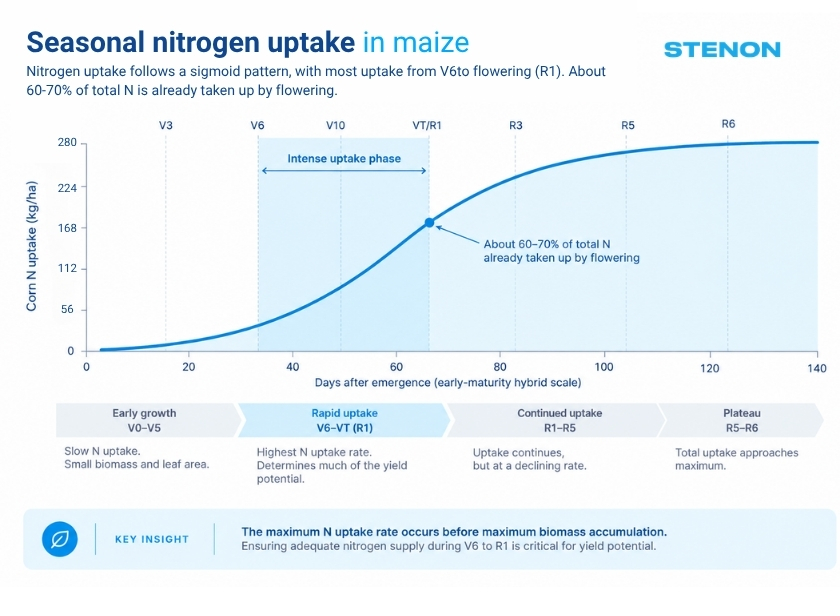
A crop does not require nitrogen at the same rate from planting to harvest. Nitrogen accumulation generally follows a sigmoid pattern: relatively slow uptake early in the cycle, followed by a period of intensive uptake as leaf area and biomass expand, and then a slowdown as the crop moves toward reproductive development and senescence. The position and duration of this intensive phase vary between crops.
Maize provides a particularly useful example.The maximum rate of nitrogen uptake occurs before maximum biomass accumulation, and roughly two-thirds of the crop’s total N may already have been taken up by flowering.
Source: California Department of Food and Agriculture (CDFA). Corn Grain Nitrogen Uptake and Partitioning – Nitrogen Management Guidelines. CDFA Fertilization Guidelines – Corn Grain https://www.cdfa.ca.gov/is/ffldrs/frep/FertilizationGuidelines/N_Corn_Grain.html
This distinction matters. Looking at a large, rapidly growing crop and asking how much nitrogen it contains today is different from asking whether sufficient nitrogen was available when the crop was determining its yield potential.
The critical question is not only “how much?”, but “when?”
This becomes especially important when we consider critical growth windows. Yield components are established sequentially. Once a particular component has been determined, nitrogen applied later cannot simply turn the clock back.
In maize, for example, the number of kernel rows is established approximately between V6 and V10, while kernels per row are particularly sensitive to stress between V12 and flowering. A nitrogen shortage during these periods can therefore have consequences that a later application cannot fully compensate for.
This is also the physiological logic behind split nitrogen applications. The objective is not simply to distribute fertilizer throughout the season. It is to ensure that nitrogen does not become limiting during the periods when important yield components are being established. A late application may improve plant N status or grain protein while still arriving too late to recover lost yield potential.
And this brings us to an important distinction in nitrogen management.
Crop nitrogen demand is not the same as fertilizer demand
Knowing how much nitrogen a crop requires does not automatically tell us how much fertilizer should be applied.
The plant does not distinguish between nitrogen originating from fertilizer and nitrogen supplied by the soil. Crop uptake combines N from multiple sources, including mineralization of soil organic matter, previous crop residues, fertilizer and other inputs.
Estimating crop demand is therefore only the starting point. Before translating that demand into a fertilizer recommendation, we need to understand how much nitrogen the soil can supply and how efficiently additional fertilizer N can be recovered by the crop.
That distinction is at the heart of precision nitrogen management.
From assumptions to actual soil information
Traditional nitrogen strategies often have to rely heavily on generalized recommendations, historical soil information and assumptions about nitrogen supply.
But nitrogen availability is dynamic.
For the grower, the practical question is therefore not simply: How much nitrogen does this crop need?
It is:
How much does the crop need, how much plant-available nitrogen is already there, and what needs to be added at the right time?
This is where Stenon’s approach to nitrogen management comes in.
With FarmLab, Stenon’s portable soil analysis device, plant-available nitrogen can be measured directly in the field, providing real-time soil insights without the delay associated with sending samples to a laboratory. Instead of treating soil nitrogen supply as an unknown part of the equation, growers and agronomists can bring current field information into their nitrogen management decisions.
Understanding crop physiology tells us when and why nitrogen matters. Understanding the soil tells us what is actually available to meet that demand. Bringing these two sides together creates the basis for more precise nitrogen management: supplying the crop according to its needs while identifying opportunities to avoid unnecessary fertilizer applications.
In the next article in our Nitrogen Management series, we will move from the plant into the soil and look at why soil nitrogen is such a dynamic system and why the amount available to a crop can change considerably during the season.
Sources:
Brown, R. H. (1978). A difference in N use efficiency in C3 and C4 plants and its implications in adaptation and evolution. Crop Science, 18(1), 93–98. https://acsess.onlinelibrary.wiley.com/doi/abs/10.2135/cropsci1978.0011183x001800010025x
Sage, R. F., Pearcy, R. W., & Seemann, J. R. (1987). The nitrogen use efficiency of C3 and C4 plants. I. Leaf nitrogen, growth, and biomass partitioning in Chenopodium album (L.) and Amaranthus retroflexus (L.). Plant Physiology, 84(3), 954–958. https://pmc.ncbi.nlm.nih.gov/articles/PMC1056701/?page=5
Ghannoum, O., Evans, J. R., & von Caemmerer, S. (2011) — Nitrogen and Water Use Efficiency of C4 Plants, in C4 Photosynthesis and Related CO2 Concentrating Mechanisms, pp. 129–146. DOI: 10.1007/978-90-481-9407-0_8. https://researchers.westernsydney.edu.au/en/publications/nitrogen-and-water-use-efficiency-of-c4-plants/
California Department of Food and Agriculture (CDFA). Corn Grain Nitrogen Uptake and Partitioning – Nitrogen Management Guidelines. CDFA Fertilization Guidelines – Corn Grain https://www.cdfa.ca.gov/is/ffldrs/frep/FertilizationGuidelines/N_Corn_Grain.html
O manejo de nitrogênio começa pela compreensão da planta
O nitrogênio é um dos nutrientes mais importantes na produção agrícola — e também um dos mais difíceis de manejar de forma eficiente.
Na Stenon, como especialistas em manejo de nitrogênio, trabalhamos com um princípio simples: melhores decisões sobre o nitrogênio começam com melhores informações. Saber quanto nitrogênio disponível para as plantas está realmente presente no solo é uma parte essencial dessas informações. Mas esse número, por si só, não é suficiente. Para tomar uma boa decisão agronômica, também precisamos entender como a cultura utiliza o nitrogênio, quando precisa dele e o que acontece quando a disponibilidade de N e a demanda da cultura não estão sincronizadas.
Este artigo inaugura uma nova série da Stenon dedicada à ciência por trás do manejo de nitrogênio. A cada mês, exploraremos um aspecto agronômico do nitrogênio: desde a demanda das plantas e a dinâmica do nitrogênio no solo até a mineralização, as perdas, a eficiência do uso do nitrogênio e as decisões práticas que os produtores enfrentam no campo.
Começamos pela própria planta.
Por que o nitrogênio é diferente
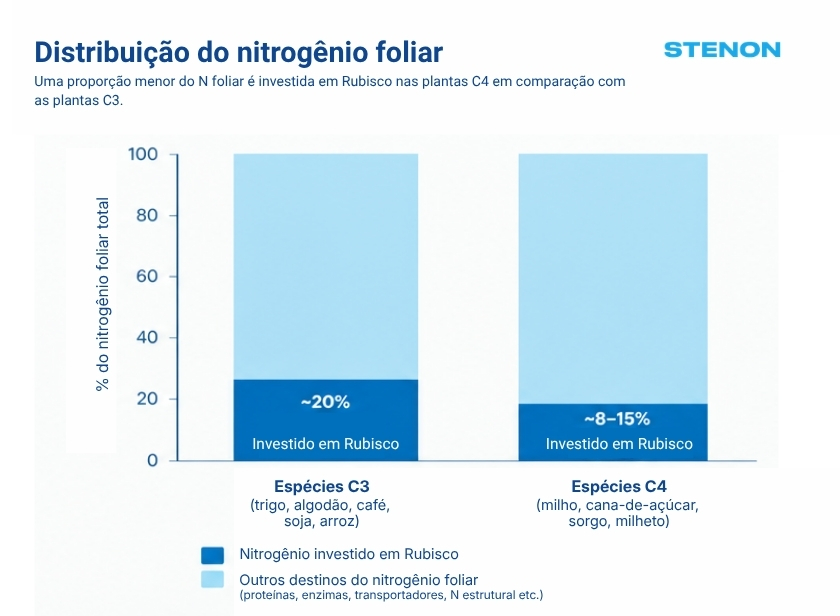
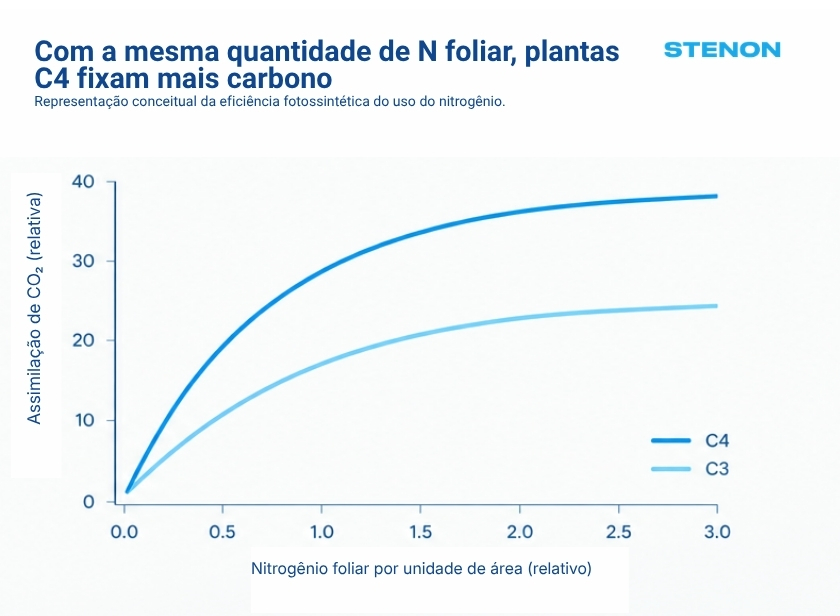
O nitrogênio não desempenha apenas uma função isolada dentro da planta. Ele faz parte de grande parte da estrutura que mantém a planta crescendo: proteínas e enzimas, clorofila, ácidos nucleicos e outros compostos essenciais.
Isso explica por que a deficiência de nitrogênio pode ter um impacto tão amplo. Quando o N se torna limitante, o efeito não fica restrito a um único processo. O desenvolvimento das folhas, a capacidade fotossintética e a capacidade da planta de formar e, posteriormente, preencher o produto a ser colhido podem ser afetados. Como o nitrogênio é móvel dentro da planta, as folhas mais velhas também podem se tornar uma fonte de N para os tecidos mais jovens quando o suprimento é insuficiente.
Essa mobilidade produz os conhecidos sintomas visuais da deficiência de nitrogênio — mas também cria um desafio para o manejo.
Quando a cultura apresenta sinais visíveis de deficiência de nitrogênio, o melhor momento para intervir pode já estar passando. Os sintomas visuais nas folhas inferiores podem indicar deficiência de N, mas esse diagnóstico visual é, por natureza, tardio: alguns componentes da produtividade podem já ter sido definidos antes que a clorose se torne evidente.
A demanda por nitrogênio não é constante ao longo do ciclo
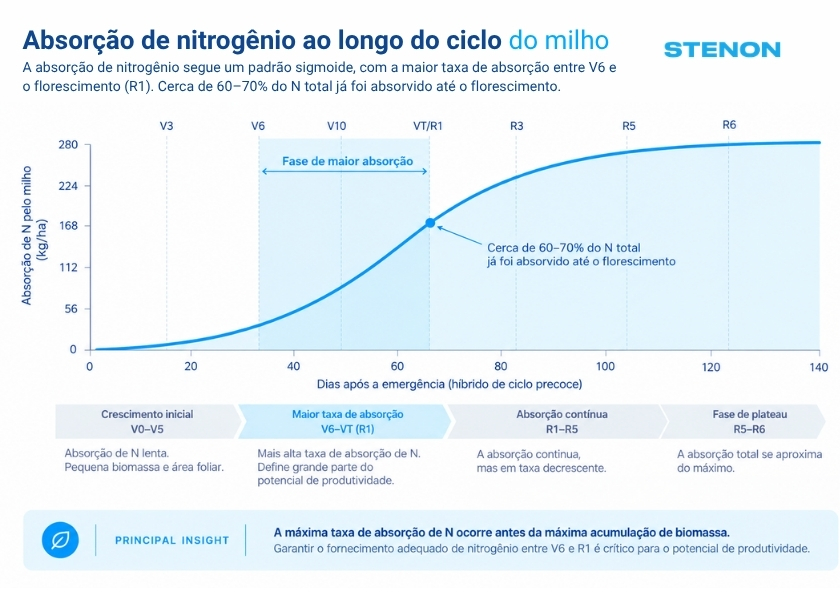
Uma cultura não necessita de nitrogênio na mesma intensidade desde o plantio até a colheita. O acúmulo de nitrogênio geralmente segue um padrão sigmoide: absorção relativamente lenta no início do ciclo, seguida por um período de absorção intensa à medida que a área foliar e a biomassa aumentam e, posteriormente, uma desaceleração à medida que a cultura avança para o desenvolvimento reprodutivo e a senescência. A posição e a duração dessa fase de absorção intensa variam entre as culturas.
O milho oferece um exemplo particularmente útil. A taxa máxima de absorção de nitrogênio ocorre antes do máximo acúmulo de biomassa, e aproximadamente dois terços do N total da cultura podem já ter sido absorvidos até o florescimento.
Essa diferença é importante. Observar uma cultura grande e em rápido crescimento e perguntar quanto nitrogênio ela contém hoje é diferente de perguntar se havia nitrogênio suficiente disponível no momento em que a cultura estava definindo seu potencial produtivo.
A questão crítica não é apenas “quanto?”, mas “quando?”
Isso se torna especialmente importante quando consideramos as fases críticas de desenvolvimento. Os componentes da produtividade são estabelecidos de forma sequencial. Uma vez que determinado componente tenha sido definido, uma aplicação posterior de nitrogênio não pode simplesmente voltar no tempo.
No milho, por exemplo, o número de fileiras de grãos é estabelecido aproximadamente entre V6 e V10, enquanto o número de grãos por fileira é particularmente sensível ao estresse entre V12 e o florescimento. Portanto, uma deficiência de nitrogênio durante esses períodos pode ter consequências que uma aplicação posterior não conseguirá compensar totalmente.
Essa também é a lógica fisiológica por trás do parcelamento das aplicações de nitrogênio. O objetivo não é simplesmente distribuir o fertilizante ao longo do ciclo. É garantir que o nitrogênio não se torne limitante durante os períodos em que importantes componentes da produtividade estão sendo definidos. Uma aplicação tardia pode melhorar o status de N da planta ou o teor de proteína dos grãos e, ainda assim, chegar tarde demais para recuperar o potencial produtivo perdido.
E isso nos leva a uma distinção importante no manejo de nitrogênio.
A demanda de nitrogênio da cultura não é o mesmo que a demanda por fertilizante
Saber quanto nitrogênio uma cultura necessita não nos diz automaticamente quanto fertilizante deve ser aplicado.
A planta não distingue entre o nitrogênio proveniente do fertilizante e o nitrogênio fornecido pelo solo. A absorção pela cultura combina N proveniente de diversas fontes, incluindo a mineralização da matéria orgânica do solo, os resíduos da cultura anterior, os fertilizantes e outros aportes.
Estimar a demanda da cultura é, portanto, apenas o ponto de partida. Antes de transformar essa demanda em uma recomendação de fertilização, precisamos entender quanto nitrogênio o solo pode fornecer e com que eficiência o N adicional proveniente do fertilizante pode ser recuperado pela cultura.
Essa distinção está no centro do manejo de precisão do nitrogênio.
De estimativas para informações reais do solo
As estratégias tradicionais de manejo de nitrogênio muitas vezes precisam se basear fortemente em recomendações generalizadas, dados históricos do solo e estimativas sobre o fornecimento de nitrogênio.
Mas a disponibilidade de nitrogênio é dinâmica.
Para o produtor, portanto, a questão prática não é simplesmente: De quanto nitrogênio esta cultura precisa?
Mas sim: De quanto a cultura precisa, quanto nitrogênio disponível para as plantas já está presente no solo e quanto precisa ser adicionado no momento certo?
É aqui que entra a abordagem da Stenon para o manejo de nitrogênio.
Com o FarmLab, o equipamento portátil de análise de solo da Stenon, o nitrogênio disponível para as plantas pode ser medido diretamente no campo, fornecendo informações sobre o solo em tempo real, sem a demora associada ao envio de amostras para um laboratório. Em vez de tratar o fornecimento de nitrogênio pelo solo como uma variável desconhecida da equação, produtores e agrônomos podem incorporar informações atuais do campo às suas decisões de manejo de nitrogênio.
Compreender a fisiologia da cultura nos mostra quando e por que o nitrogênio é importante. Compreender o solo nos mostra o que está realmente disponível para atender a essa demanda. Unir esses dois lados cria a base para um manejo de nitrogênio mais preciso: fornecer à cultura o que ela necessita e, ao mesmo tempo, identificar oportunidades para evitar aplicações desnecessárias de fertilizantes.
No próximo artigo da nossa série sobre Manejo de Nitrogênio, passaremos da planta para o solo e veremos por que o nitrogênio no solo constitui um sistema tão dinâmico — e por que a quantidade disponível para uma cultura pode mudar consideravelmente ao longo do ciclo.
Fontes:
Brown, R. H. (1978). A difference in N use efficiency in C3 and C4 plants and its implications in adaptation and evolution. Crop Science, 18(1), 93–98. https://acsess.onlinelibrary.wiley.com/doi/abs/10.2135/cropsci1978.0011183x001800010025x
Sage, R. F., Pearcy, R. W., & Seemann, J. R. (1987). The nitrogen use efficiency of C3 and C4 plants. I. Leaf nitrogen, growth, and biomass partitioning in Chenopodium album (L.) and Amaranthus retroflexus (L.). Plant Physiology, 84(3), 954–958.https://pmc.ncbi.nlm.nih.gov/articles/PMC1056701/?page=5
Ghannoum, O., Evans, J. R., & von Caemmerer, S. (2011) — Nitrogen and Water Use Efficiency of C4 Plants, in C4 Photosynthesis and Related CO2 Concentrating Mechanisms, pp. 129–146. DOI: 10.1007/978-90-481-9407-0_8.https://researchers.westernsydney.edu.au/en/publications/nitrogen-and-water-use-efficiency-of-c4-plants/
California Department of Food and Agriculture (CDFA). Corn Grain Nitrogen Uptake and Partitioning – Nitrogen Management Guidelines. CDFA Fertilization Guidelines – Corn Grain https://www.cdfa.ca.gov/is/ffldrs/frep/FertilizationGuidelines/N_Corn_Grain.html
About Stenon
Since its founding in 2018, Stenon GmbH, based in Potsdam, Germany, has become the global market leader in real-time digital soil data that is especially beneficial for agricultural producers, consultants and precision agriculture businesses. With its sensor- and cloud-based mobile measuring device FarmLab, Stenon provides agriculture businesses with essential data to make optimal and sustainable cultivation decisions, boost yield, crop quality and soil health while saving money on inputs.