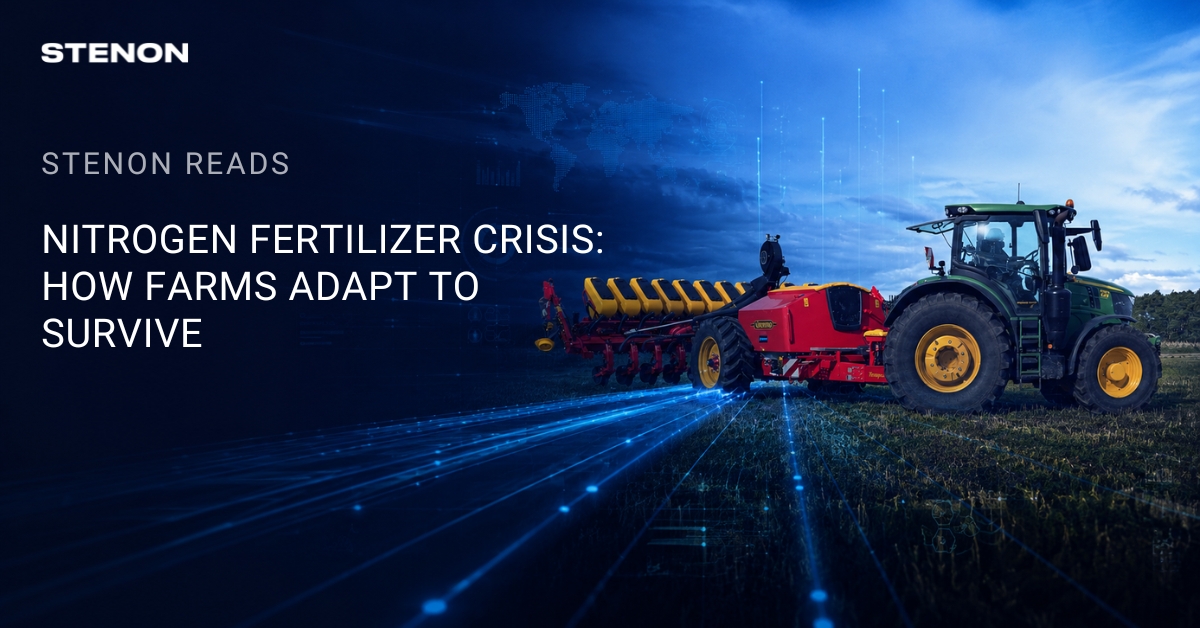
Nitrogen fertilizer has become one of the most strategically important and financially dangerous inputs in modern agriculture.As explored in our previous articles on the global nitrogen fertilizer crisis and fertilizer logistics disruption, the market is being reshaped by rising urea prices, geopolitical instability, energy market volatility, and increasingly fragile global supply chains.
Reuters reported that in April 2026 India received urea offers clustered around $1,000 per metric ton, with some bids reaching $1,136 per ton. India ultimately contracted imports at $935–959 per ton, compared with $508–512 per ton only two months earlier [1].
But unlike many other industrial inputs, fertilizer is not optional.
For most field crops, nitrogen directly determines yield potential. And yield is not only the foundation of farm profitability, it is the foundation of global food production itself.
This is why the fertilizer crisis extends far beyond agriculture.
When fertilizer prices rise dramatically while grain prices remain under pressure, entire farming businesses become economically vulnerable. Farmers are squeezed between volatile input costs and commodity markets they cannot control. And increasingly, many operations simply cannot absorb the pressure any longer.
The consequences are already visible. In the United States, more farmers filed for bankruptcy in the first quarter of 2025 than in any full year since 2021 [2].
At the same time, rising input costs are increasingly affecting day-to-day production decisions. A recent nationwide survey conducted by the American Farm Bureau Federation among more than 5,700 producers found that around 70% of U.S. farmers report they cannot afford to purchase all the fertilizer they need for the season [3].
And this is not only a farm-sector problem.
If farms reduce production, delay planting, cut fertilizer rates, or leave acreage idle, less food ultimately reaches the market. The result is pressure across the entire food supply chain from grain availability and livestock feed to food prices for consumers.
And this is no longer a theoretical risk. International institutions are already warning that sustained fertilizer inflation is beginning to influence planting decisions and future food affordability. The FAO reported that rising fertilizer costs are contributing to expectations of reduced wheat acreage in 2026, as some producers shift toward less input-intensive crops [4].
Looking further ahead, the FAO warns that if high input costs persist and farmers continue producing with fewer inputs, lower yields later this year and into 2027 could translate into higher food commodity prices and retail food inflation for several years [5].
The World Bank has also warned that the current commodity environment could intensify this pressure: fertilizer prices are projected to rise further in 2026, driven by urea costs, increasing the risk of weaker agricultural output, additional inflation, and worsening food insecurity. Under prolonged disruption scenarios, millions more people could face acute food insecurity globally [6].
In other words, the nitrogen fertilizer crisis affects not only agriculture. It affects food security itself.
So the key question becomes: How can farming businesses survive and continue producing profitably in an environment where one of their most essential inputs has become one of their greatest financial risks?
Read More