Nitrogen remains the backbone of modern agriculture. It is the nutrient most closely tied to plant growth, yield formation, and ultimately farm profitability. Yet, as explored in our previous article “Why Nitrogen Is Still the Most Expensive Guess in Farming”, it is also one of the least precisely managed inputs in the field.
Today that uncertainty is no longer just an agronomic challenge, it has become a global economic risk.
A system under pressure: why nitrogen has become unpredictable
Over the past years, the nitrogen fertilizer market has undergone significant volatility. What was once considered a relatively stable input has turned into one of the most unpredictable cost factors in farming.
A key driver behind this instability is the growing influence of geopolitical tensions on global supply chains. Nitrogen fertilizers are heavily dependent on natural gas and internationally traded raw materials. When energy markets fluctuate or trade routes are disrupted, fertilizer production costs and availability are directly affected.
According to the World Bank, fertilizer prices have experienced sharp increases during recent global disruptions, with nitrogen-based fertilizers among the most affected commodities.
At the same time, major producing countries are increasingly prioritizing domestic supply. Policy measures in China, for example, have led to reduced fertilizer exports in order to stabilize internal markets tightening global availability and putting additional pressure on prices.
Structural shifts in the fertilizer market
Beyond geopolitical dynamics, the structure of the fertilizer market itself is evolving.
Across many regions, input retail markets are consolidating. Smaller distributors are struggling to cope with price volatility, supply uncertainty, and increased capital requirements. As a result, larger players are gaining market share, reducing competition at the local level.
The OECD has highlighted how increasing concentration in agricultural input markets can limit price transparency and ultimately raise costs for farmers.
For farmers, this means fewer choices, less negotiating power, and often higher prices especially in already constrained markets.
From fertilizer prices to food prices: pressure across the supply chain
The impact of rising fertilizer costs does not stop at the farm gate, it extends across the entire food supply chain.
As fertilizer becomes more expensive and less accessible, producers are forced to absorb higher input costs to maintain yields and keep their operations viable. In many cases, these costs are passed downstream.
Institutions such as the Food and Agriculture Organization have repeatedly highlighted the direct link between input costs and global food prices, emphasizing how rising fertilizer prices contribute to increased production costs, tighter margins, and ultimately higher food prices for consumers.This creates a cascading effect: from input suppliers to farmers, from farmers to food processors, and finally to consumers. What begins as volatility in nitrogen markets ultimately affects affordability, food security, and everyday life.
The hidden cost of nitrogen
The true cost of nitrogen goes far beyond the price per tonne.
Production itself is highly energy-intensive, with ammonia synthesis relying heavily on natural gas. The International Energy Agency estimates that fertilizer production represents a significant share of global industrial energy use and emissions.
On top of production, logistics and distribution add further layers of cost – from global transport and storage to field-level application.
And critically, inefficiencies in application mean that a substantial portion of nitrogen is never used by the crop. Instead, it is lost to the environment, representing both an economic loss and an environmental burden.
From crisis to control: how precision data addresses the challenge
In a market defined by rising prices, constrained supply, and increasing pressure across the entire food value chain, efficiency is no longer optional, it has become essential.
This is where Stenon’s technology provides a practical and scalable solution, directly addressing the challenges outlined above. By enabling farmers to base fertilization decisions on real-time data rather than assumptions, Stenon brings clarity into one of the most uncertain areas of crop production. Within seconds, nutrient availability can be assessed directly in the field, allowing application rates to be adjusted with precision.
Instead of applying nitrogen “just in case,” farmers can apply exactly what is needed, no more, no less.
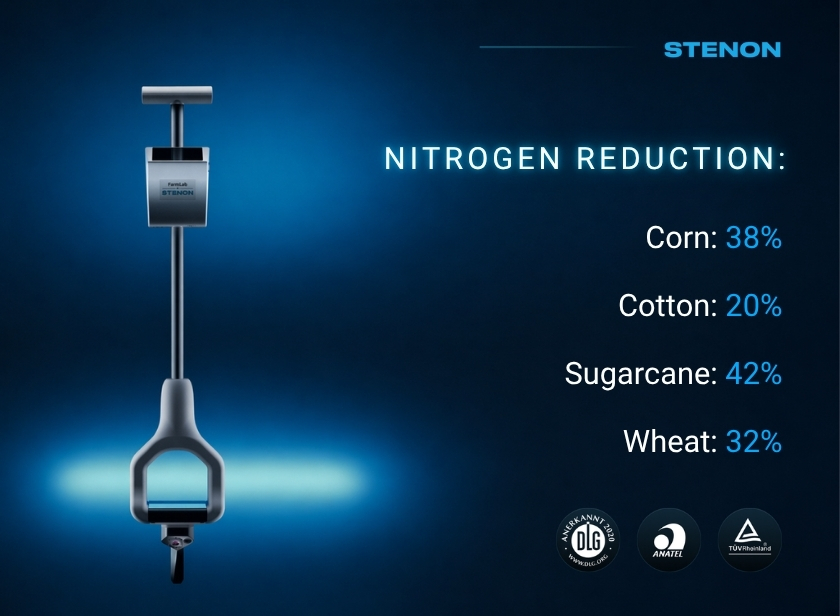
Across global deployments, this data-driven approach has consistently delivered measurable results, reducing fertilizer input while maintaining or even improving yields:
✅Corn: up to 38% nitrogen reduction
✅Cotton: up to 20% nitrogen reduction
✅Sugarcane: up to 42% nitrogen reduction
✅Wheat: up to 32% nitrogen reduction
By enabling significant input reduction without compromising performance, Stenon’s technology directly addresses the dual challenge of rising fertilizer prices and tightening supply.
At the same time, this efficiency gain has a direct impact on another critical issue: rising food prices. As production costs decrease, pressure along the food supply chain can be reduced benefiting not only farmers, but also processors, retailers, and ultimately consumers. Food producers are already moving in this direction. A clear example is Stenon’s collaboration with PepsiCo, where field implementation demonstrated 20–30% nitrogen fertilizer reduction while maintaining performance helping to improve cost efficiency at scale.
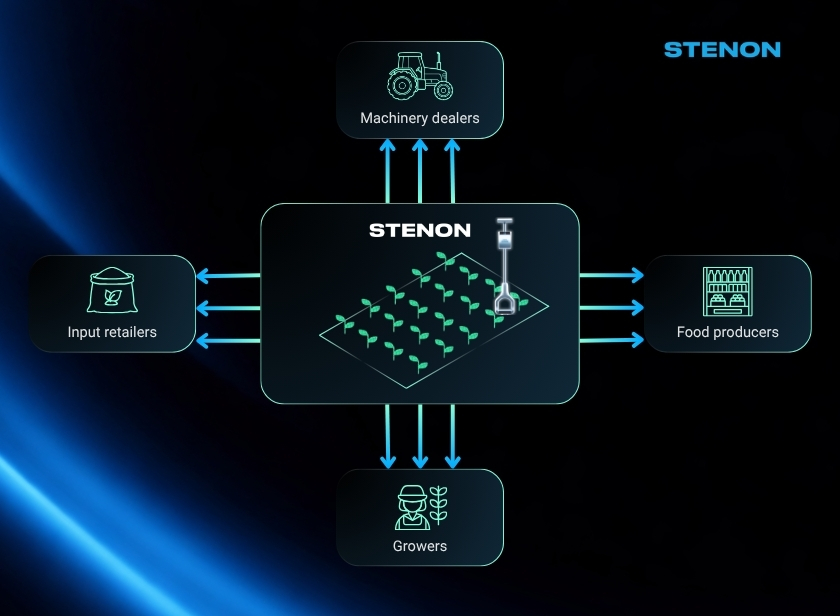
However, the impact of precision agriculture extends beyond growers and food producers. As input markets continue to consolidate, pressure is also increasing on retailers and machinery partners.
Here, data-driven soil technology opens up new opportunities across the agricultural ecosystem. Through its collaborations with input retailers and machinery dealers, Stenon has demonstrated that integrating real-time soil insights into existing portfolios can strengthen market positioning and unlock new value.
Partners benefit from increased customer retention, the ability to upsell higher-margin products, and the creation of new revenue streams. At the same time, machinery solutions are enhanced with actionable agronomic intelligence allowing businesses to differentiate themselves and remain competitive in a rapidly evolving market.
A new approach to resilience
The global nitrogen fertilizer crisis is not a short-term disruption, it is a structural shift. Market volatility, supply constraints, and rising costs will continue to shape agriculture in the years ahead.
However, while farmers and industry players cannot control global markets, they can control how efficiently inputs are used.
Precision agriculture powered by real-time data offers a way forward. Not by increasing input, but by maximizing its effectiveness.
In a world where nitrogen has become both expensive and uncertain, the most resilient strategy is clear: apply less, but apply it better.
About Stenon
Since its founding in 2018, Stenon GmbH, based in Potsdam, Germany, has become the global market leader in real-time digital soil data that is especially beneficial for agricultural producers, consultants and precision agriculture businesses. With its sensor- and cloud-based mobile measuring device FarmLab, Stenon provides agriculture businesses with essential data to make optimal and sustainable cultivation decisions, boost yield, crop quality and soil health while saving money on inputs.