Nitrogen fertilizer has already emerged as one of the most volatile inputs in modern agriculture. As discussed in our previous article, rising prices and constrained supply have reshaped how farmers plan their seasons and manage risk.
But there is a deeper layer to this crisis, one that is often overlooked.
It is not only about how much fertilizer is produced.
It is about how it moves.
Because in today’s globalized system, fertilizer is not consumed where it is produced. It travels across continents through ports, pipelines, and shipping lanes before it ever reaches the field. And when that movement is disrupted, the consequences ripple across the entire agricultural system.
Beyond production: a global movement problem
At first glance, global fertilizer production capacity can appear sufficient. Yet availability on the ground often tells a different story. Why?
Because supply is only as reliable as the systems that deliver it.
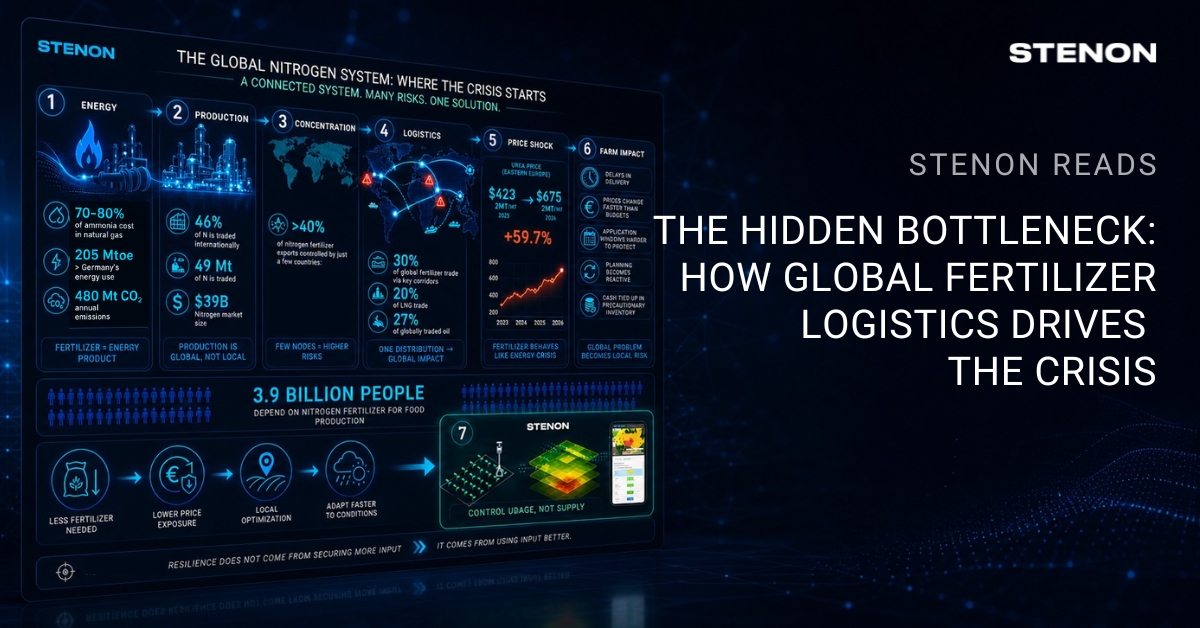
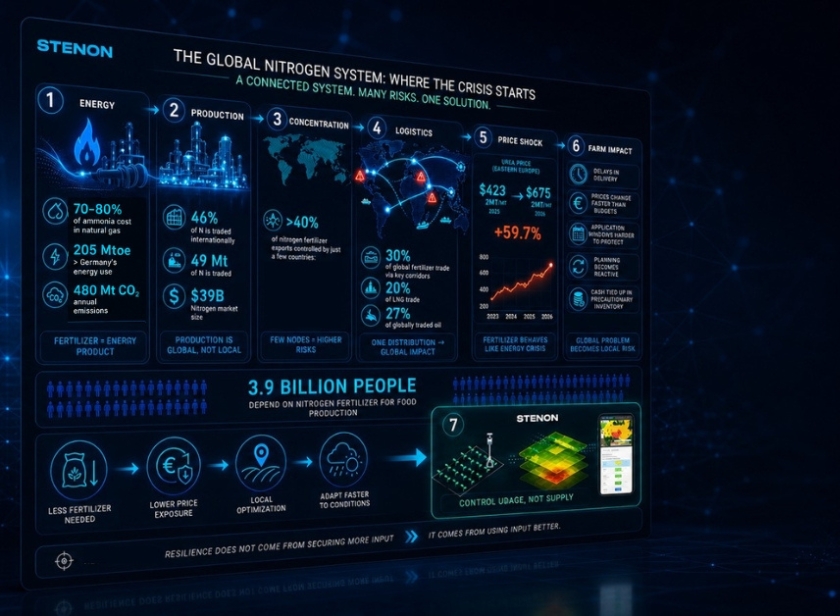
The scale of global dependency makes this clear. In 2021, 46% of the nitrogen used worldwide, 49 million tonnes of N, worth $39 billion crossed borders before reaching end users [1]. At the same time, more than 40% of global nitrogen fertilizer exports are controlled by just four countries, including Russia, China, Qatar, and Saudi Arabia [1].
This level of concentration is not just an efficiency feature, it is a systemic risk.
Even more striking is the link to global food security. Synthetic nitrogen fertilizers support food production for nearly half of the world’s population, around 3.9 billion people [1]. Of these, 1.2 billion depend directly on imported fertilizers, and this exposure rises to 1.8 billion when imported natural gas for local production is included [1].
What do these numbers mean in practice?
They reveal a system where food production at a global scale depends not only on agricultural performance but on uninterrupted trade flows and energy availability. When logistics falter, it is not just supply chains that are disrupted, it is food systems.
This is why logistics is not a side issue.
It is the system.
If production is concentrated, energy-dependent, and globally distributed, the question becomes unavoidable: how resilient can this system really be?
Where the system breaks: concentrated supply, exposed routes
Two pressure points define today’s fertilizer market: concentrated production and fragile logistics.
China remains one of the world’s key exporters. In 2026, it shipped more than $13 billion worth of fertilizers, including 4.9 million tonnes of urea, representing around 10% of global urea exports [2]. Even small policy shifts such as export inspections or restrictions can quickly tighten global supply.
Russia represents another critical node. It controls up to 40% of global ammonium nitrate trade and produces around 25% of global supply [3]. In such a concentrated market, even short-term export limitations can disrupt pricing, delay contracts, and force buyers into higher-cost alternatives.
The Gulf region adds a third layer of systemic exposure. According to IFPRI, in 2024:
- 30% of global fertilizer trade
- 20% of LNG trade
- 27% of globally traded oil
passed through a single maritime corridor, the Strait of Hormuz [4].
In addition, between 2023 and 2025, Gulf countries accounted for:
- 29% of global ammonia exports
- 36% of global urea exports [4]
This concentration creates a powerful multiplier effect. A disruption in one region does not only affect fertilizer, it simultaneously impacts energy supply, freight costs, and delivery timelines.
For the industry, this means one thing: logistics risk is no longer local, it is systemic.
Energy is the hidden input
Fertilizer logistics begins long before fertilizer exists.
Ammonia — the foundation of nitrogen fertilizers — is one of the most energy-intensive industrial products. According to the International Energy Agency, around 70% of ammonia is used for fertilizer production, while ammonia production itself accounts for 2% of global energy consumption and 1.3% of energy-related CO₂ emissions [5].
Nature Food adds further detail: producing ammonia requires 7.7- 10.1 kWh per kilogram, with 90 – 95% of this energy used for hydrogen production [1]. Today, around 99% of hydrogen used in ammonia synthesis is fossil-based, primarily from natural gas and coal [1].
The implication is direct: fertilizer availability is inseparable from energy markets.
When gas prices rise, ammonia production becomes economically constrained. This was clearly visible during the European energy crisis, when ammonia production capacity in Europe dropped by 32% year-on-year in 2022 [1].
For the industry, this reinforces a critical insight: fertilizer is not just an agricultural input, it is an energy product.
The price signal: volatility at scale
If there is one product that best reflects the instability of the nitrogen fertilizer market, it is urea.
Urea is the most widely traded nitrogen fertilizer globally and therefore the most sensitive to disruptions in energy, logistics, and trade flows. When the system tightens, urea is the first place where stress becomes visible.
The latest data illustrates this clearly. According to the World Bank’s April 2026 outlook, urea prices in Eastern Europe are projected to reach $675 per metric ton in 2026, up from $423 per metric ton in 2025, a 59.7% increase in just one year [6].
This is not a gradual shift. It is a structural signal.
A nearly 60% price increase in a single season fundamentally changes how farmers and agribusinesses operate. It transforms fertilizer from a predictable input into a financial risk variable.
What does this mean in practice?
- Input decisions become timing decisions: when to buy matters as much as how much to apply
- Working capital pressure increases: higher upfront costs tie up liquidity
- Risk behavior intensifies: farmers are pushed toward early purchasing or overbuying
At a market level, this behavior creates a feedback loop. When uncertainty rises, demand is pulled forward. When demand spikes, supply tightens further. And when supply tightens, prices accelerate.
Urea, in this context, becomes more than just a fertilizer, it becomes a real-time indicator of system stress.
For the industry, the implication is clear. Fertilizer markets are no longer behaving like stable agricultural input markets. They are behaving like energy-linked commodities, driven by volatility, external shocks, and global dependencies.
And for farmers, this shifts the challenge entirely. Fertilization is no longer just about optimizing yield, it is about managing exposure to price risk.
From global disruption to local reality
What begins as a global supply chain issue does not remain abstract for long. It quickly translates into operational pressure at the farm level, where decisions are time-sensitive and margins are tight.
While global production may still appear sufficient on paper, farmers increasingly face a very different reality: availability at the local level has become unpredictable. The challenge is no longer simply whether fertilizer exists, but when and at what cost it can be accessed.
This disconnect between global supply and local access creates a new layer of uncertainty in day-to-day farm management. In practice, it manifests in several critical ways:
- Deliveries arrive later than planned
- Prices change faster than budgets can adapt
- Application windows become harder to secure
- Planning shifts from strategic to reactive
- Cash is tied up in precautionary inventory
Farmers are no longer optimizing yield alone, they are actively managing supply chain risk. In some cases, localized shortages emerge even when global supply appears sufficient. The core issue is no longer just access to fertilizer, it is access at the right time, at a predictable cost.
From dependence to control
This is where Stenon’s approach becomes highly relevant.
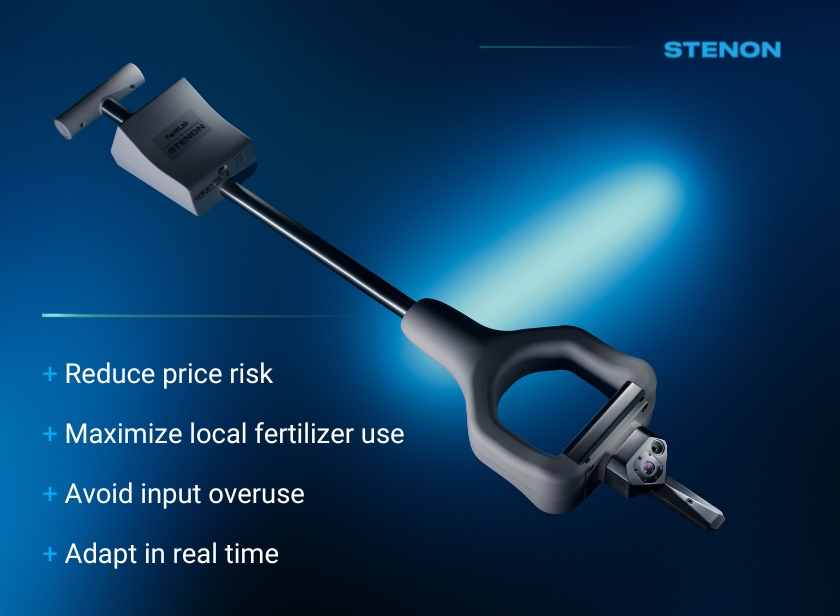
By enabling real-time, in-field measurement of plant-available nitrogen, Stenon allows farmers to optimize fertilizer use based on actual soil conditions. Instead of relying on fixed application rates or precautionary overuse, they can make precise, data-driven decisions reducing dependency on external uncertainty without compromising yield.
In practical terms, this enables:
- Lower exposure to price shocks, as less fertilizer is used as “insurance”
- More efficient use of locally available inputs
- Reduced risk of unnecessary applications
- Faster adaptation to changes in weather, crop uptake, or delivery timing
In a system defined by uncertainty, efficiency becomes a form of independence.
A new kind of resilience
The fertilizer crisis has exposed a structural weakness in global agriculture: dependence on complex and fragile supply chains.
Increasing supply alone will not eliminate this risk. As long as production and trade remain concentrated, disruption will remain systemic.
Long-term solutions such as low-carbon or decentralized ammonia production offer potential, but are not immediate fixes. Current alternatives are 2–3 times more expensive and require significantly more land and water resources [1]. Their economics also remain highly sensitive to energy prices, financing conditions, and logistics costs [7].
The conclusion is clear: resilience cannot wait for future infrastructure.
It must begin with better decisions in the field.
Because resilience does not come from securing more input.
It comes from using input better. And when supply cannot be controlled, precision becomes the most reliable source of stability.
Sources:
[1] Nature Food (2025): Low-carbon ammonia production is essential for resilient and sustainable agriculture. https://www.nature.com/articles/s43016-025-01125-y
[2] Reuters (2026): China tightens border inspections for fertilizer exports. https://www.reuters.com/world/asia-pacific/china-tightens-border-inspections-fertilizer-exports-sources-say-2026-04-28/
[3] Reuters (2026): Russia stops ammonium nitrate exports for one month amid global supply crunch. https://www.reuters.com/business/russia-imposes-restrictions-some-nitrogen-fertiliser-exports-2026-03-24/
[4] IFPRI (2026): The Iran war impacts on global fertilizer markets and food production. https://www.ifpri.org/blog/the-iran wars-impacts-on-global-fertilizer-markets-and-food-production/
[5] International Energy Agency (2021): Ammonia Technology Roadmap. https://www.iea.org/reports/ammonia-technology roadmap
[6] World Bank (2026): Commodity Markets Outlook, April 2026 price forecasts. https://thedocs.worldbank.org/en/doc/f3138644a1e8e2bb631399ae11d6c408-0050012026/related/CMO-April-2026 Forecasts.pdf
[7] Applied Energy / ScienceDirect (2023): The economics of global green ammonia trade. https://www.sciencedirect.com/science/article/pii/S0306261923000260
About Stenon
Since its founding in 2018, Stenon GmbH, based in Potsdam, Germany, has become the global market leader in real-time digital soil data that is especially beneficial for agricultural producers, consultants and precision agriculture businesses. With its sensor- and cloud-based mobile measuring device FarmLab, Stenon provides agriculture businesses with essential data to make optimal and sustainable cultivation decisions, boost yield, crop quality and soil health while saving money on inputs.